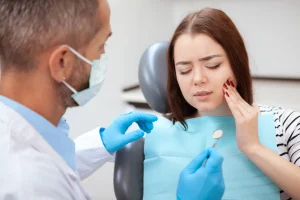
Does one tooth hit before the rest? Your bite may need a small adjustment.
If a filling, crown or another tooth feels “too high” when you close or chew, even a small contact difference can make your bite feel noticeably off. A precise occlusal adjustment can reshape the specific contact so your teeth meet more evenly.
Small adjustment. Very specific reason.

Six clues one contact may be throwing your bite off.
A bite interference can be surprisingly small. What matters is whether one area consistently feels different when your teeth come together.
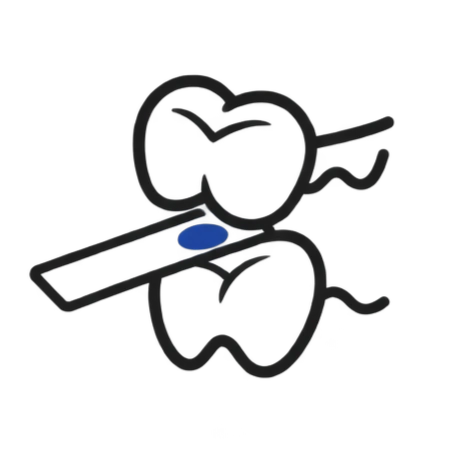
A new filling feels “too high”
If a recently restored tooth seems to touch before the others, the bite on that restoration may need to be checked.
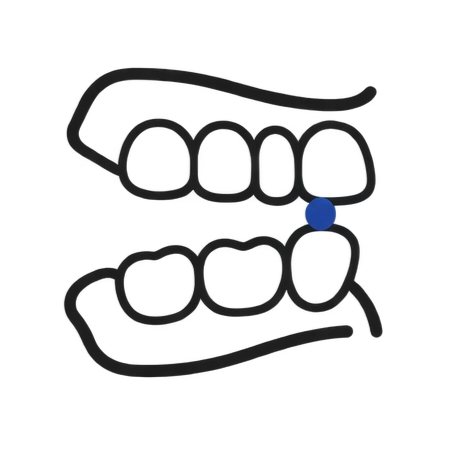
One tooth hits first
When you close slowly, you may notice one specific tooth making contact before the rest of your bite settles.
It hurts only when you chew
A tooth that feels comfortable at rest but tender under biting pressure deserves a closer evaluation.
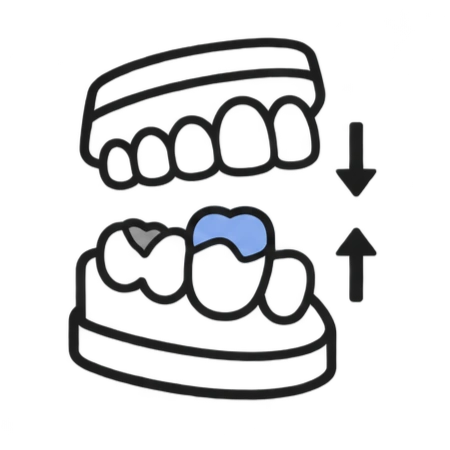
Your bite changed after dental work
A filling, crown, bridge or other treatment can sometimes leave your teeth meeting differently than they did before.

Pressure feels uneven
Chewing may feel heavier on one tooth or one side, as though part of your bite is carrying more pressure than the rest.

A restoration feels overloaded
Unexpected wear, tenderness or chipping around a filling or crown can be a reason to check how biting forces are contacting that area.
If your bite changed after dental work, you don’t have to wait and hope it “settles.”
Occlusal adjustment permanently changes a tiny part of the biting surface. That’s why we identify the interference first — and adjust only what needs adjusting.
Your teeth should meet together — not compete to be first.
Your occlusion is the way your upper and lower teeth contact when you close and move your jaw. Sometimes one small area contacts too heavily or too early, particularly after a filling, crown or other restorative treatment.
Occlusal adjustment — also called equilibration — means selectively reshaping specific biting surfaces to create more harmonious contact between the upper and lower teeth.
The important word is specific. We first need to identify a real contact problem and determine whether adjusting it makes sense. Bite adjustment should not automatically be used to explain or treat every headache, episode of grinding or TMJ symptom. Treatments that permanently alter the teeth or bite deserve a clear clinical reason.
Sometimes it’s one high spot. Sometimes the bite needs a closer look.
We don’t reshape teeth simply because a bite “feels different.” The first step is understanding where the contact is coming from and why.
Post-Restoration Adjustment
A newly placed filling, crown or bridge can be checked and selectively adjusted if one area is contacting too heavily when you bite.
- For patients whose bite feels noticeably higher or different immediately after restorative dental work.
- For a clearly identified, localized bite interference rather than a complex whole-mouth problem.
Limited Bite Adjustment
When examination confirms one or a few localized premature contacts, small amounts of tooth or restorative material can be selectively reshaped and polished.
Comprehensive Bite Evaluation
If several teeth, restorations or areas of wear are involved, we may need to evaluate the overall bite before deciding whether adjustment — or another approach — is appropriate.
- For patients with broader bite changes, multiple restorations or symptoms that cannot be explained by one obvious high contact.
Find the high spot. Adjust precisely. Check it again.
- Map where your teeth contact
We listen to what feels different and examine your bite, often using articulating paper to show exactly where your teeth are contacting.
- Adjust only what’s necessary
If we confirm a specific interference, a very small amount of tooth or restorative material is selectively reshaped and smoothed.
- Recheck your bite
You close and chew again while we reassess the contacts, making sure the adjusted area feels comfortable and your bite comes together more evenly.
200 reasons to choose us.
We don't ask you to trust us. We let our patients do the talking.
I hadn’t been to the dentist in longer than I wanted to admit, so I was expecting a lecture. Instead, the whole visit felt easy. My cleaning was gentle, everything was explained clearly, and I left knowing exactly what to keep an eye on and when to come back.
Melissa R.
Teeth Cleaning & Exam
Bethesda, MD
5.0 ★ · Over 200 reviews on Google · Read all reviews →
I had a small chip on my front tooth that bothered me in every photo. I expected a much bigger treatment, but bonding was enough. The shade matches beautifully and the tooth still looks completely natural.
Laura M.
Cosmetic Dental Bonding
Bethesda, MD
5.0 ★ · Over 200 reviews on Google · Read all reviews →
I drink coffee every day and felt like my teeth had gradually become much darker than they used to be. I wanted them brighter, but I definitely didn’t want that artificial super-white look. They helped me choose a shade that still looked like me, and the difference was exactly what I wanted. My smile looks fresher without looking “done.”
Emily S.
Professional Teeth Whitening
Bethesda, MD
5.0 ★ · Over 200 reviews on Google · Read all reviews →
I avoided the dentist for years because of a terrible experience when I was younger. By the time I finally booked, I was embarrassed about both my teeth and how anxious I was. Nobody made me feel judged. They talked through the sedation options with me beforehand, explained exactly what to expect and made the appointment feel completely manageable. It was the first time I left a dental office thinking, “I can actually do this again.”
Lauren D.
Sedation Dentistry
Kensington, MD
5.0 ★ · Over 200 reviews on Google · Read all reviews →
I used to think preventive dentistry just meant getting my teeth cleaned and coming back six months later. They actually took the time to explain why I kept getting cavities in the same areas and helped me change a few things at home. We also added extra protection to a couple of teeth that needed it. My visits feel much more proactive now instead of waiting for the next problem.
Nicole B.
Preventive Dentistry
Kensington, MD
5.0 ★ · Over 200 reviews on Google · Read all reviews →
I had been dealing with jaw soreness and painful clicking for months and wasn’t even sure whether I should see a dentist about it. The appointment was very thorough. They asked when the pain happened, checked how my jaw was moving and explained the difference between the joint and the surrounding muscles. I appreciated that the plan felt conservative and specific to what I was actually experiencing.
Sarah L.
TMJ Evaluation & Treatment
Chevy Chase, MD
5.0 ★ · Over 200 reviews on Google · Read all reviews →
I had already been diagnosed with sleep apnea but struggled with my CPAP enough that I wasn’t using it consistently. I talked with my sleep doctor about alternatives and then came to Bethesda Dental Group for an oral appliance. The fitting process was easy, the adjustments were explained clearly, and traveling is much simpler now. My wife is also very happy that the snoring has improved.
James R.
Sleep Apnea Oral Appliance Therapy
Bethesda, MD
5.0 ★ · Over 200 reviews on Google · Read all reviews →
I had a badly broken molar and kept putting the appointment off because I was nervous about having it removed. They showed me why the tooth couldn’t really be saved, talked me through everything before starting, and the actual extraction was much more manageable than I had built it up to be. I also appreciated that we talked about what to do with the space afterward instead of just stopping there.
Rachel P.
Tooth Extraction
Bethesda, MD
5.0 ★ · Over 200 reviews on Google · Read all reviews →
I went in with a toothache that had kept me up the night before and was honestly dreading hearing “root canal.” The team explained exactly what they were seeing and what would happen next. Once I was numb, the appointment was much easier than I expected, and the relief afterward made me wish I had come in sooner.
Michael T.
Root Canal Treatment
Bethesda, MD
5.0 ★ · Over 200 reviews on Google · Read all reviews →
I chipped an old filling and was convinced it was going to turn into a much bigger procedure. Dr. Shawn showed me exactly what was happening, explained my options clearly, and repaired the tooth without making the visit stressful. My bite feels completely normal again, and the new filling blends in so well I can barely see it.
Daniel M
Composite Filling Replacement
Bethesda, MD
5.0 ★ · Over 200 reviews on Google · Read all reviews →
A bite that feels wrong is worth checking before it keeps bothering you.
We accept most PPO insurance plans and can help you understand how bite evaluation or adjustment applies to your coverage. If additional eligible dental treatment is needed, Cherry, Sunbit, Proceed and Care Credit financing is also available with no hard credit check · approval in seconds · and plans from 3 to 24 months.
Your bite used to feel normal. Let’s figure out why it doesn’t now.
If one tooth hits first, a new filling or crown feels too high, or chewing simply hasn’t felt right since dental treatment, we’ll check the contacts and determine whether a precise adjustment can help.