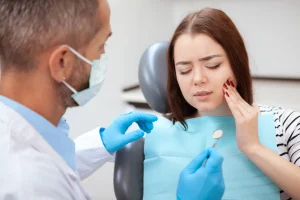
Your jaw shouldn’t hurt every time you use it.
Jaw pain, stiffness, painful clicking or difficulty opening your mouth can make eating, talking and even yawning uncomfortable. We’ll help determine what may be contributing to your symptoms and what kind of care makes sense.
The goal isn’t to chase every click — it’s to understand pain, function and what your jaw actually needs.
Six signs it may be more than a tired jaw.
Jaw sounds alone aren’t always a problem.
But pain, stiffness or changes in how your jaw moves are worth paying attention to.
Jaw or facial pain
Aching around the jaw joint, cheek or chewing muscles can be one of the most common signs of a temporomandibular disorder.
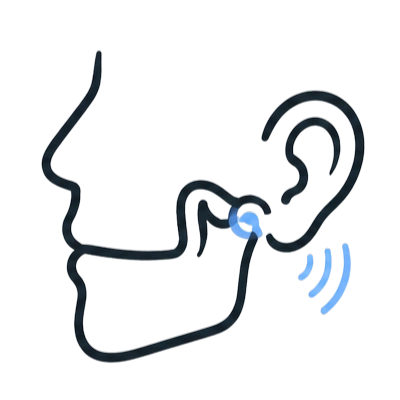
Painful clicking or popping
Jaw sounds accompanied by pain or limited movement deserve more attention than clicking that happens without discomfort.
Your jaw feels stiff
Tightness or difficulty moving your jaw normally can make chewing, speaking or opening wide uncomfortable.
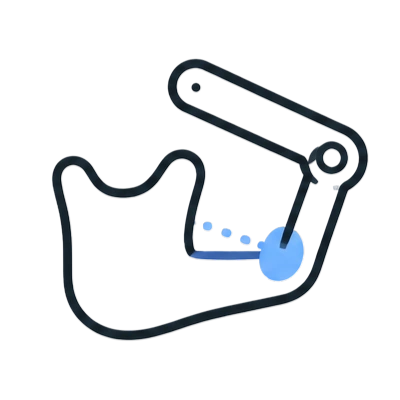
Your jaw locks
If your mouth occasionally gets stuck open or closed, or movement suddenly feels restricted, the joint should be evaluated.
Chewing makes it worse
Pain that increases while eating, biting or repeatedly using the jaw can point to stress involving the joint or chewing muscles.
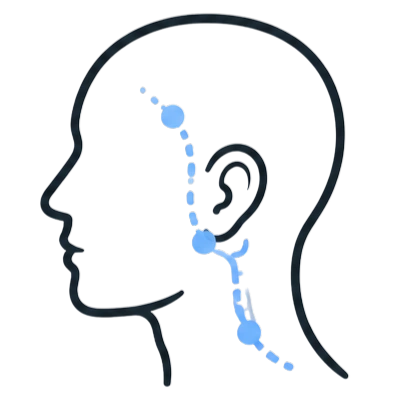
Head, ear or neck discomfort
Some people with TMD also experience discomfort that spreads into the face or neck, headaches, or symptoms around the ears.
A painless click can be common. Pain, locking or limited movement tells us more.
Clicking without pain is common and often doesn’t need treatment. Painful clicking, locking, stiffness or limited movement are different — and deserve a closer look.
Your TMJ is the joint. TMD is what happens when something isn’t working well.
You have two temporomandibular joints — one in front of each ear — connecting your lower jaw to your skull. Together with the surrounding muscles, they allow your jaw to open, close and move side to side.
“TMJ” technically refers to the joint itself. Temporomandibular disorders, or TMDs, are a group of more than 30 conditions involving the jaw joints, chewing muscles and related tissues.
That distinction matters because jaw pain does not have one single cause or one universal treatment. Symptoms may involve the joint, muscles or a combination of factors, which is why treatment should start by understanding what is actually contributing to your problem.
TMJ care should match the problem — not permanently change your bite by default.
Many TMD symptoms improve with conservative care. What we recommend depends on your symptoms, examination and what appears to be driving them.
Conservative Jaw Care
Simple measures may include temporarily reducing heavy chewing, modifying habits that overload the jaw, using heat or cold and performing appropriate jaw exercises.
- For many patients with mild or recent jaw-muscle or joint symptoms who can begin with reversible, low-risk care.
- For patients whose examination suggests an oral appliance may play a useful role in managing their specific symptoms.
Custom Oral Appliance
For selected patients, a custom night appliance may be used as part of a conservative plan to help manage jaw or muscle symptoms without permanently altering the teeth.
Coordinated Care
TMD can involve muscles, joints and other sources of facial pain, so some patients benefit from coordinated care with physical therapy, medical or other appropriate specialists.
- For persistent, complex or atypical symptoms that need care beyond what one dental approach can provide.
First understand the jaw. Then decide what it needs.
- Tell us what you’re feeling
We start with when your symptoms happen, what makes them worse, how long they’ve been present and whether your jaw ever locks or feels restricted.
- Evaluate movement & function
We assess jaw opening, movement, joint and muscle tenderness and how your symptoms behave, using imaging when clinically appropriate.
- Start with the simplest appropriate care
We explain what we find and build a conservative plan around your specific symptoms, with referral or additional care if the problem requires it.
200 reasons to choose us.
We don't ask you to trust us. We let our patients do the talking.
I hadn’t been to the dentist in longer than I wanted to admit, so I was expecting a lecture. Instead, the whole visit felt easy. My cleaning was gentle, everything was explained clearly, and I left knowing exactly what to keep an eye on and when to come back.
Melissa R.
Teeth Cleaning & Exam
Bethesda, MD
5.0 ★ · Over 200 reviews on Google · Read all reviews →
I had a small chip on my front tooth that bothered me in every photo. I expected a much bigger treatment, but bonding was enough. The shade matches beautifully and the tooth still looks completely natural.
Laura M.
Cosmetic Dental Bonding
Bethesda, MD
5.0 ★ · Over 200 reviews on Google · Read all reviews →
I drink coffee every day and felt like my teeth had gradually become much darker than they used to be. I wanted them brighter, but I definitely didn’t want that artificial super-white look. They helped me choose a shade that still looked like me, and the difference was exactly what I wanted. My smile looks fresher without looking “done.”
Emily S.
Professional Teeth Whitening
Bethesda, MD
5.0 ★ · Over 200 reviews on Google · Read all reviews →
I avoided the dentist for years because of a terrible experience when I was younger. By the time I finally booked, I was embarrassed about both my teeth and how anxious I was. Nobody made me feel judged. They talked through the sedation options with me beforehand, explained exactly what to expect and made the appointment feel completely manageable. It was the first time I left a dental office thinking, “I can actually do this again.”
Lauren D.
Sedation Dentistry
Kensington, MD
5.0 ★ · Over 200 reviews on Google · Read all reviews →
I used to think preventive dentistry just meant getting my teeth cleaned and coming back six months later. They actually took the time to explain why I kept getting cavities in the same areas and helped me change a few things at home. We also added extra protection to a couple of teeth that needed it. My visits feel much more proactive now instead of waiting for the next problem.
Nicole B.
Preventive Dentistry
Kensington, MD
5.0 ★ · Over 200 reviews on Google · Read all reviews →
I had been dealing with jaw soreness and painful clicking for months and wasn’t even sure whether I should see a dentist about it. The appointment was very thorough. They asked when the pain happened, checked how my jaw was moving and explained the difference between the joint and the surrounding muscles. I appreciated that the plan felt conservative and specific to what I was actually experiencing.
Sarah L.
TMJ Evaluation & Treatment
Chevy Chase, MD
5.0 ★ · Over 200 reviews on Google · Read all reviews →
I had already been diagnosed with sleep apnea but struggled with my CPAP enough that I wasn’t using it consistently. I talked with my sleep doctor about alternatives and then came to Bethesda Dental Group for an oral appliance. The fitting process was easy, the adjustments were explained clearly, and traveling is much simpler now. My wife is also very happy that the snoring has improved.
James R.
Sleep Apnea Oral Appliance Therapy
Bethesda, MD
5.0 ★ · Over 200 reviews on Google · Read all reviews →
I had a badly broken molar and kept putting the appointment off because I was nervous about having it removed. They showed me why the tooth couldn’t really be saved, talked me through everything before starting, and the actual extraction was much more manageable than I had built it up to be. I also appreciated that we talked about what to do with the space afterward instead of just stopping there.
Rachel P.
Tooth Extraction
Bethesda, MD
5.0 ★ · Over 200 reviews on Google · Read all reviews →
I went in with a toothache that had kept me up the night before and was honestly dreading hearing “root canal.” The team explained exactly what they were seeing and what would happen next. Once I was numb, the appointment was much easier than I expected, and the relief afterward made me wish I had come in sooner.
Michael T.
Root Canal Treatment
Bethesda, MD
5.0 ★ · Over 200 reviews on Google · Read all reviews →
I chipped an old filling and was convinced it was going to turn into a much bigger procedure. Dr. Shawn showed me exactly what was happening, explained my options clearly, and repaired the tooth without making the visit stressful. My bite feels completely normal again, and the new filling blends in so well I can barely see it.
Daniel M
Composite Filling Replacement
Bethesda, MD
5.0 ★ · Over 200 reviews on Google · Read all reviews →
Get clarity on your jaw pain without letting cost stop the conversation.
If TMJ treatment is appropriate for you, our team can help you understand available payment options. Cherry, Sunbit, Proceed and Care Credit financing is available for eligible treatment with no hard credit check · approval in seconds · and plans from 3 to 24 months. We also accept most PPO insurance plans.
Your jaw is involved in almost everything you do. It shouldn’t hurt to use it.
If pain, stiffness, locking or uncomfortable jaw movement is getting in the way of eating, talking or everyday life, come in and let us understand what’s happening.